
How Many Embryos Can Be Formed in IVF? Why the Number Cannot Be Predicted
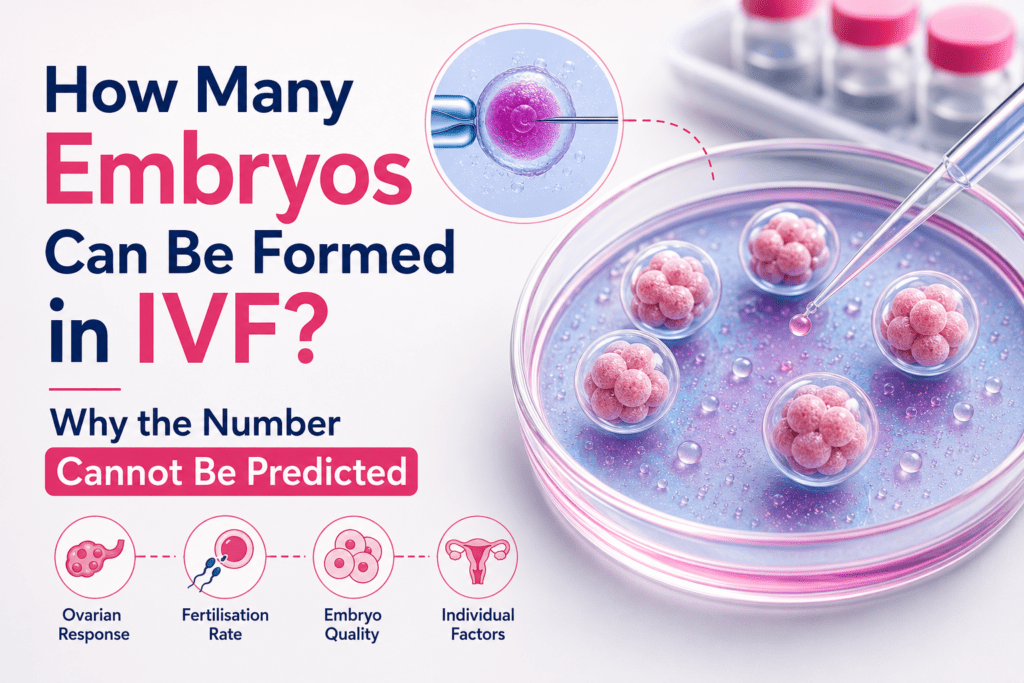
“We are planning to undergo IVF. Can you tell us how many embryos will be formed?”
This is one of the first questions many patients ask when they start thinking about IVF treatment.
Patients often want to know how many embryos they can expect from the eggs collected during the procedure. For example, someone may think that if 10 eggs are retrieved, 10 embryos should develop.
But IVF does not work with a fixed-number formula.
Think of it like planting seeds
If you plant 10 seeds in a field, you cannot guarantee that exactly 10 healthy plants will grow. Some seeds may not grow, while others may grow differently depending on their quality and the conditions in which they are grown.
IVF is not exactly the same as growing plants, but this simple example helps explain why the number of eggs available does not automatically determine the final number of embryos.
In IVF, the outcome can be influenced by egg quality, sperm quality, fertilisation and embryo development, along with other individual factors.
This is why a fertility specialist cannot promise an exact embryo number before the treatment begins.
Can a Doctor Tell Me Exactly How Many Embryos I Will Get?
No, the exact number cannot be guaranteed before an IVF cycle.
A fertility specialist can assess your age, ovarian reserve, previous reports, medical history and other clinical factors to understand what may be expected.
However, the actual outcome becomes clearer as the IVF cycle progresses.
There are several stages between egg retrieval and embryo development, and the outcome at each stage can vary from one patient to another.
What Determines Embryo Development in IVF?
Several factors can influence how embryos develop during an IVF cycle.
1. Egg Quality
Egg quality is an important factor in IVF.
The number of eggs available gives the fertility team useful information, but egg quantity alone does not determine how many good-quality embryos will eventually develop.
Age and individual reproductive factors can influence egg quality. This is one reason why IVF outcomes can vary between patients.
2. Sperm Quality
Sperm quality is equally important.
Factors such as sperm count, motility and morphology may be considered during fertility evaluation. Sperm-related factors can influence fertilisation and may also play a role in subsequent embryo development.
This is why IVF treatment should consider both egg and sperm factors, rather than focusing only on the number of eggs.
3. Fertilisation
After egg retrieval, the eggs are fertilised with sperm in the IVF laboratory.
However, successful egg retrieval does not mean that every egg will necessarily fertilise.
The number of successfully fertilised eggs can therefore be different from the initial number of eggs collected.
4. Embryo Development
After fertilisation, the embryos are monitored as they develop in the laboratory.
Some may continue developing through the expected stages, while others may stop developing.
This natural variation is another reason why the final number cannot be known at the beginning of treatment.
5. IVF Laboratory Conditions
Embryos are cultured in a carefully controlled IVF laboratory environment.
The embryology team monitors their development during this stage.
Providing an appropriate environment is an important part of embryo culture, but it cannot guarantee that every fertilised egg will continue developing.
Why Egg and Sperm Quality Matter in IVF
One of the most important things patients should understand is that IVF is not simply about numbers.
Having more eggs does not automatically mean having more good-quality embryos.
Similarly, the number of embryos alone cannot determine the outcome of treatment.
Doctors may consider several factors together, including:
- Egg quality
- Sperm quality
- Fertilisation
- Embryo development
- Patient’s age
- Ovarian response
- Previous fertility history
- Other individual medical factors
The treatment plan is then based on the patient’s individual situation.
Dr. Pooja Dhir Bhayana Explains Why Embryo Numbers Cannot Be Guaranteed
Dr. Pooja Dhir Bhayana, IVF Specialist at Sonakshi IVF Centre, explains that patients should not expect a fixed number of embryos before starting IVF.
During IVF, the eggs and sperm are provided with an appropriate environment for fertilisation and embryo development in the laboratory.
However, how many embryos ultimately develop cannot be decided beforehand.
The outcome can depend on factors such as the number of available eggs, egg quality, sperm quality, fertilisation and how the embryos develop in the laboratory.
Therefore, a doctor cannot accurately promise that a particular number of eggs will result in a particular number of embryos.
The focus should be on providing the appropriate conditions for development and then assessing the embryos as the process progresses.
Is Having More Embryos Always Better?
Not necessarily.
Patients often assume that having more embryos automatically means a better chance of success.
However, IVF outcomes are more complex than simply counting embryos.
Embryo development and quality are important considerations along with the number of embryos available.
Every IVF cycle is different. Age, ovarian response, egg quality, sperm quality, fertility history and other individual factors can all influence the treatment journey.
Therefore, comparing your IVF results with another patient’s results may not give you a meaningful picture of your own situation.
What Should You Ask Your IVF Doctor?
Instead of asking only:
“How many embryos will I get?”
you can ask:
- What do my reports tell us about my egg quality?
- How is my ovarian reserve?
- What does my partner’s semen analysis indicate?
- Are there any sperm-related factors that may affect fertilisation?
- What can we realistically expect from my IVF cycle?
- How will embryo development be monitored?
- How is embryo quality assessed?
- Which factors are most important in my individual situation?
These questions can help you understand your IVF journey more clearly and set realistic expectations.
Can IVF Doctors Predict the Number of Embryos From the Number of Eggs?
No. The number of eggs alone cannot predict the final number of embryos.
A doctor can estimate the expected response using your medical history, investigations and ovarian response.
However, the actual outcome becomes known only as the IVF process moves through fertilisation and embryo development.
This is why an exact embryo number should not be promised before treatment.
Frequently Asked Questions
1. How many embryos can be formed during IVF?
There is no fixed number. The outcome depends on factors such as egg quality, sperm quality, fertilisation and embryo development.
2. Does egg quality affect embryo development?
Yes. Egg quality is an important factor that can influence fertilisation and subsequent development.
3. Does sperm quality matter in IVF?
Yes. Sperm-related factors can influence fertilisation and may also play a role in embryo development.
4. Why doesn't every egg result in an embryo?
There are several stages between egg retrieval, fertilisation and embryo development. The outcome can vary at each stage.
5. Can my doctor guarantee the number of embryos before IVF?
No. Your doctor can provide an estimate based on your individual reports and clinical factors, but the exact number cannot be guaranteed.
6. Is having more embryos always better?
Not necessarily. Embryo development and quality are important considerations along with the number available.
7. Can two patients have different IVF results?
Yes. Age, egg quality, sperm quality, ovarian response and other individual factors can lead to different outcomes.
8. Does having fewer embryos mean IVF will fail?
No. The number of embryos alone cannot determine the outcome of an IVF cycle.
9. Why is the IVF laboratory important?
Embryos are cultured in a controlled laboratory environment where their development can be monitored by trained embryology professionals.
10. When will I know how many embryos have developed?
The outcome becomes clearer as the IVF cycle progresses through fertilisation and embryo culture.
11. How is embryo quality assessed?
Embryologists monitor embryo development using established laboratory assessment methods. Your fertility specialist can explain what the assessment means for your treatment.
12. Should I compare my IVF results with someone else's?
It is better not to. Every patient has different biological and medical factors, so outcomes can vary.
13. What should I focus on instead of embryo numbers?
Focus on understanding your egg and sperm factors, embryo development, quality and the treatment plan recommended for your individual situation.
14. Why can't IVF results be guaranteed beforehand?
IVF involves several biological stages, and the outcome of each stage can vary. Therefore, exact results cannot be promised in advance.
15. What should I discuss with my fertility specialist before IVF?
Discuss your fertility history, test results, ovarian reserve, egg and sperm factors, previous treatments and realistic expectations for your individual IVF cycle.
IVF Guidance Across Haryana
Every IVF journey is different, and the number of eggs retrieved does not always tell you how many embryos may ultimately develop. Patients may have questions about fertilisation, embryo development, embryo quality, and the next steps after egg retrieval.
Sonakshi IVF Centre provides fertility care across multiple cities in Haryana, allowing patients to discuss these concerns with a medical team and understand what their individual IVF cycle may involve. The treatment approach is planned according to factors such as age, ovarian response, fertilisation results, embryo development, and overall fertility history.
Patients can connect with the nearest Sonakshi IVF Centre at:
The Key Takeaway
There is no fixed formula for knowing how many embryos will develop during IVF.
Egg quality, sperm quality, fertilisation, embryo development and individual patient factors all contribute to the outcome.
So, instead of focusing only on a number, patients should understand their individual fertility factors, how the embryos are developing and what their results mean for treatment.
IVF is not about promising a number. It is about understanding your individual situation and making informed treatment decisions with the guidance of a fertility specialist.
If you are considering IVF, discuss your reports, treatment options and realistic expectations with your fertility specialist.


