
ICSI vs IVF Difference: What Every Couple Trying to Conceive Should Actually Know
There’s a moment couples reach, and nobody talks about it enough. The doctor says “IVF” or “ICSI,” and suddenly you’re expected to understand two acronyms that sound almost identical but aren’t. That’s the honest starting point for this piece. Understanding the ICSI vs IVF difference isn’t complicated once someone breaks it down properly, so let’s do that here, plainly, without the jargon that usually makes fertility clinics feel intimidating.
So What’s the Difference Between ICSI and IVF?
In simple terms, both are fertility treatments where an egg is fertilised outside the body, in a lab. That part is the same. The real difference between ICSI and IVF is how the sperm meets the egg.
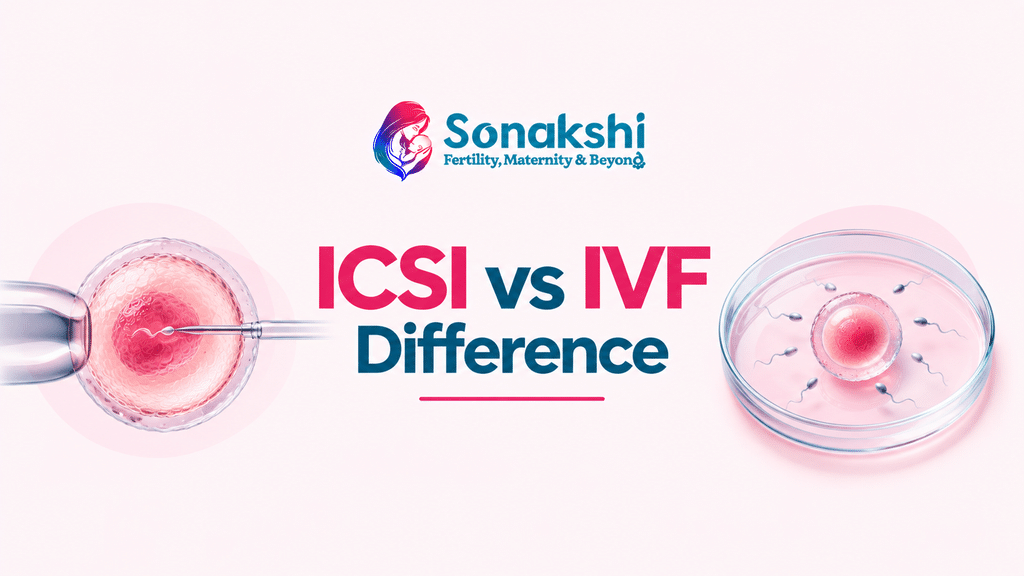
In a conventional IVF procedure, thousands of sperm are placed near an egg in a dish, and nature is left to do its work. One sperm swims to the egg and fertilises it on its own, more or less like it would inside the body, just relocated to a lab environment.
ICSI, short for intracytoplasmic sperm injection, skips that natural selection entirely. An embryologist picks a single, healthy-looking sperm and injects it directly into the egg using a fine needle. No swimming required. No waiting to see if fertilisation happens by chance.
That’s the core of ICSI vs IVF right there. One relies on natural sperm competition; the other bypasses it completely.
When Is ICSI Recommended, and Why Does It Matter?
Here’s the part patients genuinely want answered. When is ICSI recommended? Mostly when there’s a male factor infertility treatment need, low sperm count, poor sperm motility, abnormal sperm shape, or previous failed fertilisation with regular IVF.
Who needs ICSI treatment, then? Couples where the male partner has a very low sperm count, men who’ve had a vasectomy reversal, cases involving frozen sperm with reduced quality, or unexplained infertility where standard IVF didn’t work the first time. ICSI for male infertility and ICSI for low sperm count are honestly the two biggest reasons doctors lean toward it.
IVF for male infertility is still used in milder cases, where sperm parameters aren’t severely affected, and natural fertilisation odds remain reasonably strong.
Breaking Down the ICSI vs IVF Procedure, Step by Step
The early stages of both are identical, and this surprises people. Ovarian stimulation with hormone injections, monitoring through scans, egg retrieval under sedation. Up to that point, there’s no difference at all.
Then comes the fork. In the ICSI procedure, a single sperm goes directly into each mature egg. In the IVF procedure, sperm and eggs are combined in a dish and left to fertilise naturally overnight.
After that, both paths merge again: fertilised eggs become embryos, embryos are monitored for a few days, and the healthiest one (or two) gets transferred into the uterus. So really, ICSI treatment vs IVF treatment differs at one specific, narrow stage, not the whole journey.
ICSI vs IVF Success Rate: The Question Everyone Asks First
Let’s be honest, this is usually the first thing anyone wants to know. The ICSI vs IVF success rate conversation isn’t as simple as “one is better.” ICSI success rate tends to be higher specifically for fertilisation rates in cases of male infertility, because it removes the guesswork. But IVF success rate, when sperm quality is normal, can be just as strong, sometimes comparable, because pregnancy success depends heavily on egg quality, uterine lining, and embryo health too, not fertilisation method alone.
So IVF or ICSI, which is better, genuinely depends on the couple’s specific diagnosis. There’s no universal winner here, and any clinic claiming otherwise isn’t being fully honest with you.
ICSI vs IVF Cost: What You’re Actually Paying For
ICSI vs IVF cost is where a lot of anxiety creeps in, understandably. ICSI treatment cost runs somewhat higher than standard IVF treatment cost, because of the additional lab work, the embryologist’s skill involved, and specialised equipment used for the injection process. The gap isn’t massive, but it’s real, and worth discussing openly with your clinic before starting, not after.
ICSI Treatment in India and IVF Treatment in India: A Growing, More Affordable Option
Something worth mentioning here, quietly but importantly, is how ICSI treatment in India and IVF treatment in India have become genuinely accessible in recent years. Costs remain significantly lower than in Western countries, while lab standards and embryologist expertise have improved considerably. Couples travelling from abroad for treatment in India isn’t rare anymore; it’s becoming common.
At Sonakshi IVF Center, this is exactly the space we sit in. Years of hands-on experience, transparent conversations with patients about which path, ICSI or IVF, actually fits their diagnosis, and a lab setup built around precision rather than assumptions. No two cases are treated identically here, because no two fertility stories are the same.
If you’re comparing clinics in the region, it’s worth knowing that being recognised as the best IVF center in Haryana isn’t just about equipment. It’s about the small things, how carefully a case history is reviewed, how honestly a doctor explains real odds instead of inflated promises, and how a couple is supported emotionally through what is, quietly, one of the hardest waiting periods of their lives.
The Bottom Line on ICSI vs IVF Difference
Neither treatment is inherently superior. ICSI vs IVF comes down to what’s actually causing the infertility. Male factor issues usually point toward ICSI. Normal sperm parameters with other fertility challenges often mean conventional IVF works just fine. A good fertility specialist will tell you which one your case needs, not which one is more expensive or more advanced sounding.
Frequently Asked Questions
1. What is the main difference between ICSI and IVF in simple words?
In IVF, sperm and egg are placed together, and fertilisation happens naturally in the dish. In ICSI, a single sperm is manually injected into the egg. The lab steps before and after are almost identical; only the fertilisation method changes.
2. Is ICSI more painful or risky than IVF for the woman?
No. The physical process for the woman- egg retrieval, stimulation, embryo transfer- is exactly the same regardless of whether ICSI or IVF is used. The difference happens entirely in the lab, after the eggs are already retrieved.
3. Does ICSI guarantee pregnancy since it forces fertilisation?
No, and this is a common misunderstanding. ICSI increases the chance of fertilisation happening, but pregnancy still depends on embryo quality, uterine receptiveness, and overall reproductive health, not the injection method alone.
4. Can couples choose ICSI even without male infertility?
Yes, some clinics use ICSI as a precaution when previous IVF cycles had poor fertilisation, even without a clear male factor diagnosis, though it’s usually a doctor’s recommendation rather than a default choice.
5. How much more expensive is ICSI compared to regular IVF?
It varies by clinic, but ICSI typically costs somewhat more than standard IVF due to the specialised lab technique and embryologist time involved. Ask your clinic for a clear cost breakdown before starting treatment.
6. Which one has a better success rate, ICSI or IVF?
Neither is universally better. ICSI shows stronger fertilisation rates specifically in male infertility cases. When sperm quality is normal, IVF success rates are comparable. The right choice depends entirely on individual diagnosis.


