
Embryo Grading in IVF: What Do Grade 1, 2, 3, and 4 Embryos Mean?
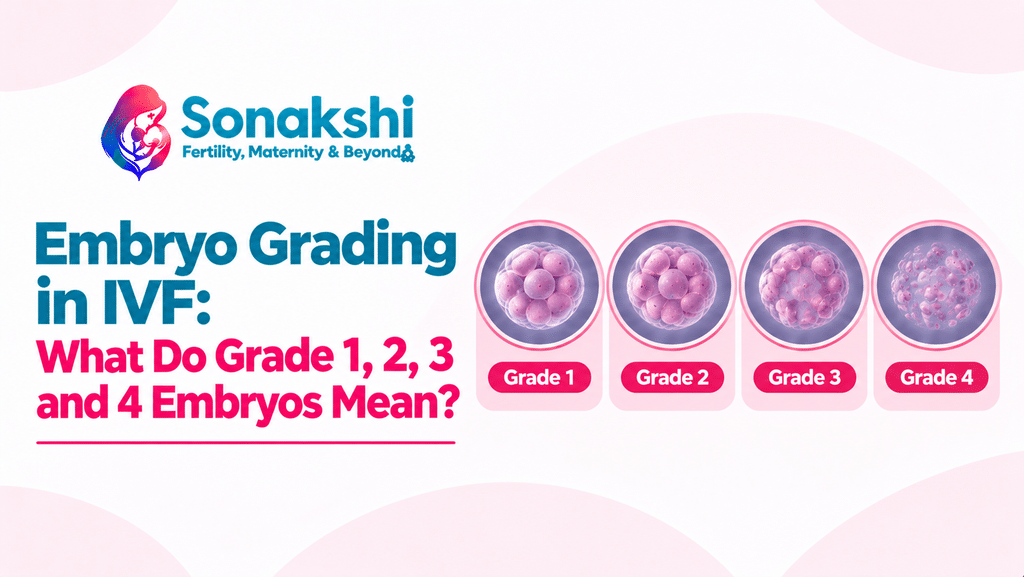
The call from the clinic usually comes in the afternoon. “We have four embryos. Two are Grade 1, one is Grade 2, one is Grade 3.” Then silence, because nobody has explained those numbers yet. This is the moment embryo grading in IVF becomes the most important phrase in your week. So let’s slow down. Simple words. One step at a time.
What Is Embryo Grading in IVF, Really?
Embryo grading in IVF is a scoring method. The embryologist looks at each embryo under a microscope and checks its shape, its cells, and its speed of growth. That check is called embryo morphology. The score that comes out of it is embryo quality grading. Think of a school report card, but for a ball of cells smaller than a grain of salt.
One honest thing first. A grade tells you how an embryo looks today, not who your child will be. Hold that thought; we’ll come back to it.
IVF Embryo Grades 1, 2, 3 and 4: The Simple Meaning
Most labs grade a Day 3 embryo, when it has about 6 to 8 cells. These IVF embryo grades work like this:
- Grade 1: Cells are equal in size, with almost no fragments (tiny broken bits). This is a good quality embryo.
- Grade 2: Cells are slightly uneven, with fragments under about 25 percent—still a good quality embryo in most clinics.
- Grade 3: Cells are clearly uneven, with roughly 25 to 50 percent fragments. Fair quality, but it can still work.
- Grade 4: Heavy fragments, very uneven cells, slow growth. Lower chances.
That is a basic embryo grading chart in words. One warning, though: some labs flip the scale, so Grade 4 might be the best. Always ask which IVF embryo grades your clinic uses before comparing notes with a friend.
Blastocyst Grading: The Day 5 Report Card
By Day 5 or 6, a healthy embryo grows into a blastocyst. Blastocyst grading uses a code like 4AA. The number (1 to 6) shows how much the embryo has expanded. The first letter scores the inner cell mass, the part that may become the baby. The second letter scores the trophectoderm, the outer layer that may become the placenta. A is best, B is good, C is fair.
Embryo grading in IVF at this stage feels more like reading a code than a number. Many doctors trust blastocyst grading more than Day 3 scores because the embryo has had longer to prove itself. If your report shows letters, your embryo grading chart is simply this code. A 3BB, by the way, can still be a good quality embryo.
Embryo Quality and Pregnancy: How Strong Is the Link?
Now the question everyone really wants answered. Embryo quality and pregnancy are connected. A good quality embryo usually has a better chance of implanting. But the link is not a straight line. Some Grade 3 embryos become healthy babies. Some Grade 1 embryos don’t implant. Why? Because embryo morphology shows only the outside. It can’t show the chromosomes inside, or how ready your womb is.
So embryo quality and pregnancy walk together, but never promise each other. Even the best embryo grading in IVF results can’t measure egg age, uterine lining, or hormones. If you’ve had repeated failures, ask your doctor about chromosome testing (PGT-A) alongside embryo quality grading. It adds a layer the microscope can’t see.
What Can You Do While You Wait?
You can’t change an embryo’s grade after it forms, but you can prepare your body. Eat regular meals, sleep well, avoid smoking and alcohol, take folic acid if your doctor advised it, and follow your medicines exactly. Then ask for your written embryo grading chart. Ask how many embryos reached the blastocyst stage, which one will be transferred, and why. Understanding embryo grading in IVF, and your embryo quality grading report, makes the wait a little lighter.
Choosing the Best IVF Center in Haryana
If you are searching for the best IVF center in Haryana, don’t go by advertisements alone. Look for a clinic that explains embryo grading in IVF openly, has its own embryology lab, shows you real scores, and talks about success rates honestly, including what can go wrong. Many people type “best ivf center near me” at midnight, and that’s fine. But distance matters less than trust.
Sonakshi Care is one fertility clinic couples can approach for a clear explanation of their embryo report. Whichever clinic you pick, carry a few questions. Which grading system do you use? What are my IVF embryo grades? What is the plan for the lower-graded ones? Ask them to explain each embryo grading chart in plain words. If someone explains it without hurry, that’s a good sign.
Back to that afternoon call. A Grade 3 is not a closed door, and a Grade 1 is not a promise. Embryo grading in IVF is a map, not the destination.
Frequently Asked Questions
1. What is embryo grading in IVF and why does every clinic do it?
Embryo grading in IVF is the scoring of embryos under a microscope so the doctor can pick the best one for transfer. Embryo quality grading looks at cell number, cell size, fragments, and growth speed, which together are called embryo morphology. It helps decide which embryo goes first and which is frozen. It’s a guide, not a verdict.
2. Which is better, Grade 1 or Grade 4?
In most labs, Grade 1 is best, and Grade 4 is the weakest. These IVF embryo grades describe Day 3 embryos. A few clinics reverse the scale, so ask for your clinic’s embryo grading chart. Embryo morphology is judged by a trained person, so small differences between labs are normal. Embryo grading in IVF is never exactly identical everywhere.
3. Can a Grade 3 or Grade 4 embryo lead to a healthy baby?
Yes, sometimes. A good quality embryo has better odds, but lower grades have also resulted in births, though chances are lower. Embryo quality and pregnancy depend on more than looks, such as chromosomes and egg age. Even low IVF embryo grades should be discussed with your doctor before any embryo is discarded, because embryo quality grading and embryo morphology are only part of the picture.
4. What is blastocyst grading and how do I read 4AA?
Blastocyst grading gives a code of one number and two letters. In 4AA, the 4 shows good expansion, the first A scores the inner cell mass, and the second A scores the outer layer. Blastocyst grading of 4AA or 5AA is strong, and AB or BB can still be a good quality embryo. Check the code against your embryo grading chart.
5. Does a higher grade guarantee pregnancy?
No. Embryo quality and pregnancy are linked but not locked together. Embryo morphology and blastocyst grading can’t show chromosomes, and even a good quality embryo needs a receptive womb. Embryo grading in IVF improves your odds of choosing wisely, but it cannot promise. Embryo quality grading is guidance, so keep hope without expecting certainty.
6. Can I improve my embryo grades, and when should I ask for more tests?
A formed embryo can’t be changed, but healthy habits before the next cycle may support egg and sperm health. If you keep seeing low IVF embryo grades, ask about genetic testing, sperm DNA tests, or a changed protocol. Compare the embryo grading chart and blastocyst grading from each cycle, and ask how embryo morphology and embryo quality and pregnancy outcomes line up in your case. Embryo grading in IVF becomes more useful when you track it over time.


