
Hydrosalpinx and IVF: Causes, Symptoms, Treatment and Pregnancy Chances
Picture a couple on their fourth IVF cycle. The embryos graded well. The transfer went smoothly. And the result was negative, again. Nobody in the room can say why, and that kind of confusion feels strangely familiar to thousands of couples. Sometimes the answer sits somewhere nobody looked closely enough: inside the fallopian tube. That is where hydrosalpinx and IVF meet, and honestly, more women should hear about it much earlier.
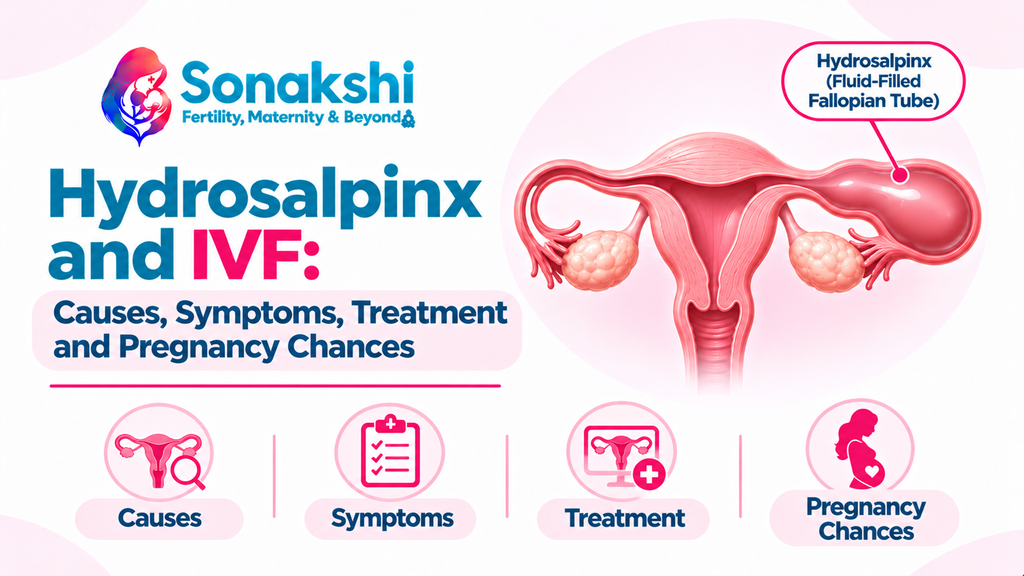
Hydrosalpinx (say it hi-dro-SAL-pinks) means a fallopian tube that is blocked at its far end and swollen with fluid. Doctors call this fluid in the fallopian tube, and it is one of the best-known forms of blocked fallopian tubes. Imagine a water balloon that can never drain, sitting right beside the womb where an embryo is trying to settle. Not ideal. Not ideal at all.
What Is Really Happening Inside the Tube?
A healthy tube is an open, soft pathway. The egg travels through it, meets sperm, and the young embryo drifts toward the womb. When the far end seals, usually after damage, the tube keeps making a little fluid, and it has nowhere to go. It collects. The tube stretches. Its inner lining gets flattened and tired.
Here’s the odd part. IVF happens in a lab, so you’d think a damaged tube wouldn’t matter. It does. When there is fluid in the fallopian tube for months or years, some of it can flow backward into the womb, again and again, right where the embryo needs a calm place to land. This is one quiet reason behind IVF implantation failure that nobody mentions early enough.
What Causes Hydrosalpinx?
Infection is the main reason. Pelvic inflammatory disease, often after chlamydia or gonorrhoea, can scar the end of the tube shut. But it isn’t only that. Endometriosis, earlier pelvic or abdominal surgery, a burst appendix, an old ectopic pregnancy, and genital tuberculosis (a real concern in India) can all do it. Not all blocked fallopian tubes are the same, though. Some close near the womb, some at the far end. Hydrosalpinx is the far-end kind.
Sometimes there’s no clear history at all. A woman may have had a mild infection years ago and never known. There’s no shame in that. The damage is often old.
Hydrosalpinx Symptoms: Why Many Women Notice Nothing
This is the tricky part. Hydrosalpinx symptoms can be completely silent. When they do appear, they usually look like this:
- A dull ache or heaviness in the lower belly, often on one side
- Pain during sex
- Watery vaginal discharge, sometimes in sudden bursts
- Pelvic pain around periods
- Trouble getting pregnant, which is often the only sign
Because hydrosalpinx symptoms are so easy to confuse with period pain or ordinary discomfort, a woman can carry the condition for years. Most are diagnosed during an infertility workup. A transvaginal ultrasound often shows fluid in the fallopian tube as a sausage-shaped pocket. An HSG (a dye X-ray of the tubes) or a keyhole look inside the pelvis can confirm it.
Why Hydrosalpinx and IVF Don’t Mix Well
To understand hydrosalpinx and IVF, think of the womb lining as soil and the embryo as a seed. If the soil keeps getting washed with an unfriendly liquid, the seed struggles. Researchers believe the fluid may be toxic to embryos, may wash them out mechanically, and may disturb the lining’s ability to accept them. Removing the tube has been shown to restore the lining’s expression of HOXA10, a gene linked to implantation.
The numbers are hard to ignore. In a large review of 5,592 women, untreated hydrosalpinx meant a pregnancy rate of about 19.7 percent, against 31.2 percent for women with other tubal blockages. Delivery rates were 13.4 percent versus 23.4 percent, and early pregnancy loss was about 44 percent versus 31 percent. Other analyses suggest the chance of conceiving with hydrosalpinx can be roughly halved.
So hydrosalpinx and pregnancy through IVF is still possible, but untreated tubes tilt the odds. If you’ve had repeated IVF implantation failure with good-quality embryos, ask your doctor to look at your tubes. Really, ask. It is one of the more fixable reasons behind IVF implantation failure, and it’s often missed.
Hydrosalpinx Treatment Before IVF: Your Real Options
The encouraging part: hydrosalpinx treatment exists, and it works best before embryo transfer. Not every case of blocked fallopian tubes needs the same fix, so here are the main routes.
Salpingectomy removes the damaged tube by keyhole surgery. Proximal tubal occlusion blocks the tube near the womb so fluid can’t flow back, while the tube stays in place. Ultrasound-guided aspiration drains the fluid with a thin needle, though it can refill. Sclerotherapy, where a solution is injected to shrink the tube lining, is another option some centres use. Most of these count as hydrosalpinx surgery or tube-focused procedures, and the choice depends on scarring, age and ovarian reserve.
What does the evidence say? One network analysis found proximal tubal occlusion and salpingectomy were both better than no treatment for ongoing pregnancy. Another summary found no significant advantage of either procedure for pregnancy or live birth. To be fair, a recent analysis cautions that no option has been proven to raise live birth rates, even though the benefit for ongoing and clinical pregnancy supports current recommendations. So the honest summary: treating the tube helps, and the exact method matters less than having an experienced team choose well.
Is hydrosalpinx surgery risky? Any surgery has risks. Removing a tube can, in rare cases, affect blood supply to the ovary, and heavy scarring can make the operation harder. That’s why a careful surgeon explains the options, and why occlusion is sometimes chosen when removal looks difficult. Some doctors also suggest freezing embryos first, then transferring after healing. Ask whether that suits you.
Hydrosalpinx and IVF: What Are Your Real Pregnancy Chances?
After treatment, things improve. Success with IVF after laparoscopic salpingectomy or sclerotherapy may reach 38 to 40 percent. One systematic summary suggests that where the pregnancy rate is about 19 percent without surgery, salpingectomy may lift it to between 27 and 52 percent. In a seven-year real-world study, women with mild disease did best, and the median time to pregnancy was nine months.
Small reports even show that women with one affected tube and one healthy tube sometimes conceive naturally after surgery. One multi-centre report of 25 such women recorded no ectopic pregnancies. Small numbers, though. Don’t plan your life around it.
Your own chance depends on age, ovarian reserve, tube condition and embryo quality. Statistics describe groups, not you. But hydrosalpinx and pregnancy results look very different once the tube problem is handled, which is the whole point of treating it first.
Practical Steps for Hydrosalpinx and IVF Before Your Next Cycle
Start with paperwork. Take your old HSG and ultrasound reports to a fertility specialist and ask directly whether there is fluid in the fallopian tube. Ask if surgery should come before transfer. Ask what that hydrosalpinx surgery means for your ovaries, and how long recovery takes, since many doctors prefer a gap of a month or two before the next attempt. If you’ve had unexplained IVF implantation failure, ask whether your tubes were ever properly checked. And don’t ignore small hydrosalpinx symptoms like one-sided pelvic ache, even if they seem minor. Your hydrosalpinx treatment plan should be explained clearly, in words you understand.
Where to Get Help
At Sonakshi Care, couples with tube problems can begin with something simple: a clear review of their scans, HSG, and cycle history. If your reports mention blocked fallopian tubes, fluid in the fallopian tube, or unexplained IVF implantation failure, bring them along. That first conversation about hydrosalpinx symptoms, hydrosalpinx treatment, and hydrosalpinx and pregnancy is where good fertility care starts, and it’s worth having before another expensive cycle.
Many families searching for the best IVF center in Haryana want the same few things: a doctor who explains, a lab that is open about its work, and honest success numbers. Look for experience with tubal disease and clear advice on whether hydrosalpinx surgery should come before transfer. You can also search for the best IVF center near me, but judge any clinic by how it handles hydrosalpinx and IVF planning, not by the label alone.
One last thought. Hydrosalpinx and IVF can feel like a double blow: first the diagnosis, then the wait. But a swollen tube is a problem with a known fix, and hydrosalpinx treatment has helped many women move forward. This article is for information and doesn’t replace advice from your own doctor.
FAQs
1. Can I get pregnant naturally with hydrosalpinx?
It is possible but unlikely, especially when both tubes are affected. The fluid can stop the egg and sperm from meeting, and if conception does happen, the risk of miscarriage or ectopic pregnancy is higher. Hydrosalpinx and pregnancy can sometimes work naturally if only one tube is affected and the other is healthy, particularly after surgery. But anyone who has blocked fallopian tubes or has noticed hydrosalpinx symptoms and is trying to conceive should see a fertility specialist rather than wait it out.
2. Do I always need surgery before IVF if I have hydrosalpinx?
Not always, but doctors often recommend it, especially when fluid in the fallopian tube is clearly visible on ultrasound. The goal of hydrosalpinx surgery is to stop the fluid from reaching the womb. Very small hydrosalpinx may be managed differently, and aspiration is sometimes used. Your doctor will decide after reviewing scans and your history. Anyone planning hydrosalpinx and IVF treatment should ask this question before the first transfer, not after the third.
3. Is salpingectomy or tubal occlusion better?
Studies show broadly similar pregnancy results. Tubal occlusion is a lighter procedure and may suit women with heavy scarring or a difficult pelvis. Salpingectomy removes the problem completely. For hydrosalpinx and IVF outcomes, your surgeon’s judgment and experience matter more than a one-size answer. Whichever hydrosalpinx surgery is chosen, ask about risks to the ovary and the expected recovery.
4. How long after surgery can I start IVF?
Many doctors suggest waiting roughly one to two menstrual cycles, though timing varies from person to person. Your body needs to heal, and your doctor will want to confirm everything looks right on a scan. Follow the plan your clinic gives for hydrosalpinx treatment and don’t rush it. A few weeks of patience can be better than a failed cycle.
5. Can hydrosalpinx cause repeated IVF failure?
Yes, it can. Fluid and inflammation may stop the embryo from settling properly, which is why unexplained IVF implantation failure should prompt a check of the tubes. Research on hydrosalpinx and IVF consistently shows lower implantation and pregnancy rates and higher miscarriage risk when the tube is left untreated. That said, it isn’t the only cause of failure. Embryo quality, womb lining, and other factors count too, so a full workup is wise.
6. How do I know if I have hydrosalpinx, and when should I see a doctor?
Many women have no hydrosalpinx symptoms at all, which is why it is often found during infertility testing. If you have lower belly pain on one side, pain during sex, unusual watery discharge, a history of pelvic infection or endometriosis, or you’ve been trying for a year without success (six months if you’re over 35), book a fertility consultation. A simple scan and HSG can show whether blocked fallopian tubes or hydrosalpinx and pregnancy problems are part of your story.


