
IVF for Blocked Fallopian Tubes: Can You Still Get Pregnant?
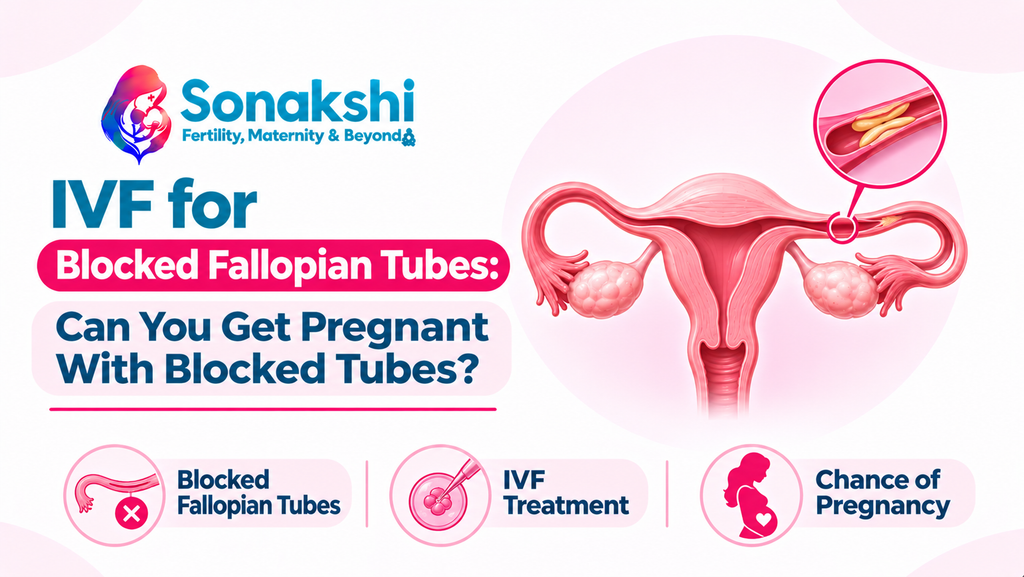
Nobody really prepares you for this moment. You try for months, maybe years, and then one dye test says your tubes are blocked. The first question is always the same: Is IVF the answer for blocked fallopian tubes? For many couples, yes. And pregnancy with blocked tubes is possible, just not the way people first imagine it.
What Blocked Tubes Actually Mean
Each month, an egg leaves the ovary and slips into the fallopian tube. Sperm meets it there. The fertilised egg then travels, slowly, down to the womb. If the tube is shut, that meeting never happens. That is tubal infertility in plain words, and it accounts for a big share of female infertility cases.
What shuts the tube? Pelvic infections, old tuberculosis, endometriosis, fibroids, a burst appendix, a past ectopic pregnancy, even earlier surgery. Any of these can leave fallopian tube damage behind. Sometimes only one side is affected. Sometimes it is bilateral tubal blockage, meaning both sides, and that changes the whole plan. Most women feel nothing. No pain, normal periods. That silence is the confusing part.
Can You Get Pregnant Naturally With Blocked Tubes?
It depends. If one tube is open and healthy, natural conception can still happen. If both are closed, rarely. Pregnancy with blocked tubes is mostly seen when the blockage is partial, and there is a catch: a higher risk of ectopic pregnancy, where the embryo grows outside the womb. That is an emergency. Sharp one-sided pain or bleeding in early pregnancy needs a doctor the same day. No waiting, no home remedies.
How Doctors Confirm the Blockage
Usually with an HSG, a dye test where X-ray pictures follow the dye through your womb and tubes. Some clinics use a saline ultrasound instead, with no radiation. A laparoscopy, where a tiny camera goes in through a small cut, shows the tubes directly and sometimes lets the surgeon fix things in the same sitting. One honest note: a muscle spasm can fake a blockage on HSG, so doctors sometimes repeat the test before labelling any fallopian tube damage. Your partner’s semen report and your egg reserve test (AMH) matter too. The tube is only one piece.
Blocked Fallopian Tube Treatment: Surgery or IVF?
Blocked fallopian tube treatment is not one-size-fits-all. A small blockage near the womb can sometimes be cleared by cannulation. Scar tissue around the tube can be cut away with laparoscopic surgery. A badly damaged tube may be removed. Or you skip the tube altogether.
Many specialists follow a rough rule. Younger woman, mild blockage, no other problems? Surgery is worth discussing. Severe bilateral tubal blockage, fluid-filled tubes, age above 35, low egg reserve, or a sperm problem? IVF usually comes first. Repaired tubes can stay fragile, and the ectopic risk stays too. Good blocked fallopian tube treatment is about the safer route, not the cheaper-looking one.
Why IVF for Blocked Fallopian Tubes Works So Well
Here is the neat part. IVF skips the tubes completely. Eggs are collected, joined with sperm in a lab, and the embryo is placed straight into the womb. IVF for blocked fallopian tubes works because the damaged tube is never needed. In fact, IVF with blocked tubes is the very reason IVF was invented. The first IVF baby, born in 1978, came to a mother whose tubes were blocked.
The journey in short: about ten days of hormone injections to grow several eggs, a brief egg collection under light sedation, three to five days of embryo growth in the lab, then the transfer. A blood test about two weeks later gives the result. Two weeks. Long ones.
Hydrosalpinx and IVF After Tubal Surgery
Sometimes a blocked tube fills with fluid. Doctors call it hydrosalpinx. That fluid can leak into the womb and make it harder for an embryo to stick. Research suggests removing or sealing such a tube before treatment improves results, which is why IVF after tubal surgery is often a planned step, not a failure. Usually, you wait a cycle or two to heal.
IVF after tubal surgery also suits women who had their tubes tied years ago, or whose reversal did not work. Reversal can succeed, but results vary, and the ectopic risk remains, so IVF is often the steadier path.
What Are the Real Chances?
No honest doctor promises. Age matters most. Under 35, good centres often report roughly 40 to 50 percent success per cycle, falling gradually with age. IVF for blocked fallopian tubes often does better than IVF for other causes, because the eggs and womb may be perfectly healthy. Only the road was closed. With bilateral tubal blockage, some couples still need two or three tries, and that is normal. Anyone going through IVF with blocked tubes should ask for age-wise results, not one flattering headline figure. In tubal infertility cases, patience is part of the plan. Costs in India vary by city and clinic, often a few lakh rupees per cycle with medicines extra, so ask for a written estimate.
Choosing the Right Clinic
Searching “best ivf center near me” is where most couples begin, and that is fine. Just filter the list. Look for qualified fertility specialists, a clean lab with experienced embryologists, clear pricing, honest age-wise results, and doctors who explain instead of rush.
Families across Haryana ask another question: which is the best IVF center in Haryana? A title cannot answer that. Visit, ask how they handle IVF for blocked fallopian tubes, see how they treat hydrosalpinx, and notice whether you feel heard.
Sonakshi Care is one name couples in the region shortlist when they look for fertility care. A consultation there can cover your tube tests, compare blocked fallopian tube treatment with IVF, and give you a written plan. Ask about the lab, the doctors’ experience, and the costs. Good clinics welcome those questions.
What to Do Next
Planning pregnancy with blocked tubes starts with testing. Get your HSG or ultrasound done if you have tried for a year, or six months if you are over 35. Test your partner as well. Treat pelvic infections early, since they quietly cause fallopian tube damage. Stop smoking, which harms tubes and eggs. If surgery is suggested, ask whether IVF after tubal surgery would still be needed. Do not lose years hoping tubes will open by themselves. They rarely do.
So, can you get pregnant with blocked tubes? Yes, often, with the right route. Tubal infertility sounds final, but it is really a plumbing problem, and IVF with blocked tubes goes around the plumbing. Even serious fallopian tube damage is not the end of the story. IVF for blocked fallopian tubes gives many couples a clear, medically proven path.
FAQs
1. Can IVF for blocked fallopian tubes work if both tubes are completely closed?
Yes, it can. With bilateral tubal blockage, natural pregnancy with blocked tubes is very unlikely, because the egg and sperm cannot meet. But IVF with blocked tubes does not depend on the tubes at all. The egg is taken straight from the ovary, fertilised in the lab, and placed in the womb. For couples whose main problem is tubal infertility, and whose eggs, sperm, and womb are healthy, this route often gives a real chance of a healthy baby. Age and egg reserve still matter, so a proper check-up comes first.
2. Is surgery better than IVF for blocked tubes?
Not always, and not never. Blocked fallopian tube treatment through surgery makes sense for young women with a mild, limited blockage and no other fertility problems. If the damage is severe, both sides are shut (bilateral tubal blockage), or you are older, IVF for blocked fallopian tubes is usually faster and safer. Many women also need IVF after tubal surgery when a damaged tube is removed, or a repair fails. Ask your doctor to explain the odds for your own case, because the best blocked fallopian tube treatment is the one matched to your age, tests, and time.
3. How long does IVF for blocked fallopian tubes take, and does it hurt?
One cycle usually takes about four to six weeks from the first injection to the pregnancy test. Injections can cause mild bruising or bloating. The egg collection is done under light sedation, so you sleep through it, and the embryo transfer feels like a routine pelvic exam. Most women say the waiting hurts more than the procedure. IVF with blocked tubes follows the same steps as any other IVF cycle, so you are not signing up for anything harder. A later frozen embryo transfer may add a few weeks.
4. Will blocked tubes change my periods or hormones?
Usually not. The ovaries keep working normally, so periods, ovulation, and hormones often look fine even with fallopian tube damage. That is why tubal infertility can go unnoticed for years. Clues can include pelvic pain, unusual discharge, or a history of infection or surgery, but many women have none of them. A blocked tube is a mechanical problem, so only an HSG, ultrasound, or laparoscopy can confirm it. If your cycles are regular but you are not conceiving, ask about tube testing early, because untreated fallopian tube damage can worsen after repeated infections.
5. What is the success rate of IVF for blocked fallopian tubes, and how many cycles will I need?
It depends mostly on age, egg quality, and the sperm report. Under 35, many good centres see around 40 to 50 percent per cycle, and the number drops after 38 or so. IVF for blocked fallopian tubes often performs better than IVF for other causes, because eggs are frequently healthy. In tubal infertility with bilateral tubal blockage, doctors often suggest planning for two or three cycles. Results after IVF after tubal surgery are similar when a hydrosalpinx was treated first. Couples choosing IVF with blocked tubes should also remember that pregnancy with blocked tubes by IVF is not a guarantee, only a strong option.
6. Is IVF for blocked fallopian tubes risky, and when should I call a doctor?
IVF is generally safe, but not risk-free. Ovarian hyperstimulation can cause bloating and, rarely, severe swelling. Twins are more likely if more than one embryo is transferred. Ectopic pregnancy can still happen, though less often. Call right away for severe belly pain, heavy bleeding, fainting, rapid weight gain, or breathlessness. Untreated tubal infertility caused by infection may bring back pelvic pain, so follow-up matters. Ask whether your blocked fallopian tube treatment plan deals with fluid-filled tubes first, especially with bilateral tubal blockage. And if pregnancy with blocked tubes happens by chance through a partly open tube, get an early scan. IVF after tubal surgery also needs a few weeks of healing before the cycle starts, and any new fallopian tube damage should be reported promptly.


